Thursday, May 18, 2023

A New, Unexpected, Path

How does that saying go??? 

If you want to make God laugh, tell him your plans.

Apparently God had quite the hysterical laughing session with us at Weber Haus. 

Cause we had plans. Those plans were made as we would begin to transition, for the first time in over 10 years, into the world without babies and toddlers. God was laughing. 

Because... 

Yup. For those of you who have had children and can read a sonogram photo...that's showing two babies. TWINS! It's still as unbelievable for me to type it out as it probably is for you to read the words. But Weber Haus will become party of 8 by the end of September. For those of you who were wondering why I haven't been posting as much school-related content and haven't been as active on Twitter or other forms of social media, hopefully this news provides and explanation. I spent a good couple months not having an appetite for ANYTHING and feeling icky constantly. Thankfully that has subsided as my belly has started to grow...and I mean grow. I went from easily hiding it one week to full on baby bump the next!

With the unexpected news comes unexpected decisions. The thought of having to do, yet another set of maternity leave lesson plans is enough to send my anxiety through the roof (those who know what that includes...you get it). More importantly, to also try to find a daycare option that will have not one but two infant openings in January that ALSO doesn't cost more than my monthly take home. 

Spoiler Alert...there isn't one. 

Finally, the desire of this mama to get to focus on just being a mama...along with the amazing support and willingness of my husband (another post in the future about him and how awesome he has been through this entire experience) led us to determine that it is time for me to step away from the classroom and stay home. A time for me to be able to focus on the literal health and growth of Weber Haus and be fully present for them. I love teaching. And leaving the classroom is a difficult decision, but I do so peacefully. No ill-will for the profession, school, colleagues, or students. And that really is a good way to walk, because it leaves the door open to come in again when the time is right.

I plan to document our family's additions on my personal blog more often. Blogging has always been a sort of therapeutic outlet for me, and I look forward to writing more on our personal blog while I allow my teaching one to become more of an archive. As life balanced between school and home became more difficult, the writing got put on the back burner (or completely off the burner) and I'm excited to bring it back.

So...feel free to browse this blog for ideas in the classroom, but be aware. Many links may become inactive and there won't be updates for a good time. If you have pulled resources from here before, make sure you have your own copy. Anything that was created by me may be gone once my Google Drive is removed. 

Happy Teaching...and keep doing great things in the classroom for kids all over!

Saturday, September 17, 2022

Student Voices, Reflection, and Making Changes

This school year in an effort to build more of a community classroom, I started having short, simple conversations with small groups on Fridays. We call this Community Circles. This post is not about Community Circles. This post is about reflecting on student voices...and how many times, they're right. 

SCENE: Last Friday, during our Community Circle discussion students were talking about this prompt.

I love it when a teacher...

I hate it when a teacher... 

I always participate in these conversations and I joined one team of boys. They were talking about how they hate it when teachers assign homework at the end of the hour, they love it when teachers have energy and they can feed off then energy. They love it when teachers share about their lives outside of school.

And then one student, looks me dead in the eyes, and says "I hate it when teachers make us do unnecessary worksheets." And to make sure I got the point (I already had...) he nods right at me, refusing to break eye contact. 

I get it. You think I do too many worksheets. 

Ooof! 

I explained at that time, that everything I have them do in class has a purpose. Even the worksheets. While they may not see the purpose immediately...I do. 

Still. It sat with me. 

Do I really make sure each paper I give the class to complete has a distinct purpose or do I sometimes fall back on what's easy for me to do. 

Most of the time I am very intentional with what I have them do, but sometimes it is just easier to have them fill out the worksheet. 

Truth is. I can do better. 

Now I sit here, reworking my lesson for Monday. Probably one of my favorite lessons of the year, because that worksheet that goes with it isn't necessary. I can get students to pull the same information through different methods. I can assess their ability to pull all the pieces together and answer our big question through a Google Form at the conclusion of the lesson, and I can do it all without having to make copies in the morning.

Real-time reflection and action.

Teachers. When you're lucky enough to get a student who is willing to provide constructive criticism, to your face, in the right context and in a respectful way consider their words. And if possible show them you get it. Show them you hear it. Because, truth is, if they trust you enough to tell you, there's a level of respect there that deserves to be returned. 

Wednesday, January 5, 2022

Daily Logs and Building Skills

I've been wanting to blog more regularly. However, the last few years have definitely provided an atmosphere that has made it difficult for consistency. Even when I do have an idea for a post many times I'm tired or I just can't bring myself to do it, and even when I do it takes a long time to actually get me to where I'm publishing it. So I decided to change things up a little bit and instead of waiting for the inspiration of a blog post or a big project to share, I decided to start sharing just simple activities and strategies that I use on a regular basis. I would love for this to be a weekly post focusing on something that I did that week. I feel like that might be a little ambitious so we'll shoot for once a month and if I get more than that it's bonus!

I'm cheating a little bit with this one, because this is a strategy that I used prior to Christmas break. But it's a good one so I feel like it's worth it. This a collaboration between my teacher, bestie, Becca Hawthorne, and myself. (PS...find yourself a good teacher friend who you can bounce idea off of. I can't tell you how many ideas have become awesome because of chatting with Becca).

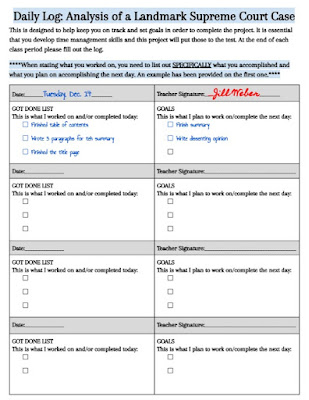
We find ourselves doing a lot of projects, and trying to work in different employability skills. Incorporating those "soft skills" that students really need (and want) to learn to develop. One of the things our students constantly talk about wanting to improve is their time management and organization of many tasks over a series of days. We've played around with using daily logs before. But this final one that we came up with worked really well and had just a couple extra elements in it.

First off.. We start with a Got Done List. This term "got done list"  came to us from our amazing counselor. She uses it as a strategy at the end of the day rather than making a to-do for tomorrow she makes a got done list for the day. This way she can feel accomplished with things but she got done. (BRILLIANT!!! And definitely one for personal use as well as the classroom)

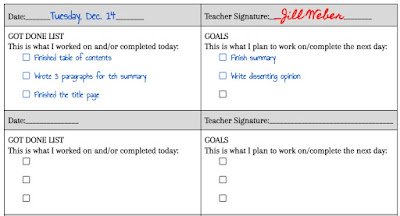
We figured this was a great strategy for students to use on project work days. So the first section of our daily log is the "Got Done List". What did you get done? They listed off in a bullet like format. Depending on what they worked on. It may be one thing. Or maybe they got three things done in a day. There's no specific requirement other than they have to be specific. They can't just say worked on research, they need to be specific on what they researched and where they researched it.


The next column is labeled "Goals" and asks students to make a list of what they like to try to work on tomorrow. This is that organization piece to the employability skills. They know they have a lot of tasks to complete, and trying to organize what needs to be done and when is an important life skill. This section is meant to help them develop that ability.


The final piece to this puzzle is the teacher signature. This was the brilliant addition by Miss Hawthorne! This allows the teacher to check in with each student on what they accomplished for the day. In order to get the signature they have to physically show what they claim to have accomplished. So if they worked on Google slides, they need to show me the specific slides they got done.  I won't sign off unless I can see proof of the work they accomplished. And then when I glance at their list for tomorrow. Gives me an opportunity to ask them if there's anything I can do to help or if there's anything they need from me to be successful. It's a great little check-in at the end of the class and gives me an opportunity to pick out anyone who may be struggling with time management and could use a little more guidance and attention from me. This might just be my favorite part of the entire log sheet! 

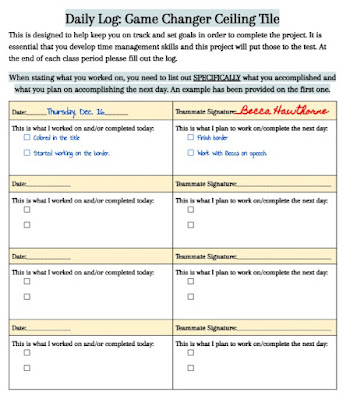
Now, I took this project log, that's meant for an individuals, and I adapted it for my class final group project. The log is essentially the same, except instead of my signature, they need a teammate to sign off on their log. This does two things. It helps with the time management organization piece that the individual log did, and it adds in an accountability piece as well. I make sure to take time at the beginning to explain the importance of their signature and verifying the work completed by their partners. They can't backtrack later and say, " well Janie really didn't do the work that she said she did, we were just being nice..."  That doesn't fly. This hopefully helps them to have conversations before there's conflict about work ethic. It's also allows me, as teacher, to facilitate having the difficult conversations if its needed. Typically I find if students know that the expectation is for them to log their progress each day, they tend to make more progress!


Want to copy of these logs? Just click below, make a copy and it's yours! Just don't actually claim that is yours... ðŸ˜‰


Also...follow my teacher bestie on Twitter! @MsHawthorne266  she's the best!

Sunday, January 2, 2022

REAL "Self" Care

If I have one more person tell me to take some time to "rest" and practice "self-care" by getting a massage and my nails done with a Starbucks coffee in the other hand, I may seriously lose it. (Although, I'll still take that Starbucks drink...). I am so tired of people thinking that all I need to do is ADD SOMETHING ELSE TO MY PLATE IN ORDER TO FEEL BETTER. 

Newsflash. My plate has been overflowing for the better part of 3 years!!!! 

Something needs to be done. The rate I'm going (and many other teachers) isn't sustainable. I need change, and I have some ideas. Yesterday I posted about my 2022 word of the year being "ok" and working on learning how to be "ok with ok". Now I'm going to tell you why I really chose that word. Yes, what I said in the post is true...but it's also necessary to help me on the path to REAL self-care.

You see...REAL self-care to me isn't just a mani-pedi and a girls night out. REAL self-care is making small changes to my daily routine that can help relieve some of the stress that has been balling itself up at the top of my shoulders for the better part of 3 years. 

In order to do this. I need some reflection. Some real, honest reflection on what is the most stressful things right now and how can I work on those areas to help relieve it. I thought I'd highlight two areas of growth in the classroom and two areas of growth outside of school where I'm going to focus my energy. Taking stress off my plate at growing at the same time. Win-Win

AT SCHOOL:

1. Being OK with OK - - I am very good at what I do. This is not me "bragging," this is my truth. I am very good at what I do (one of my resolutions a couple years ago was to own it and stop denying it because I was afraid of people judging me for being too cocky). I work incredibly hard, I am creative, I am a whiz with document formatting and creating engaging lessons. I can whip out a new activity in lightning speed (just ask my team...) My classroom just works. It works because I WORK. I collaborate with some of the BEST teachers on Twitter, I learn new strategies, I read, I talk with our curriculum specialists, I brainstorm with my team...it all has made a HUGE difference in the quality of my teaching. The downside to this is that I am constantly creating new activities, lessons, and projects. I love it, I truly do. A lesson that went well would go even better if I did "this". I need to stop. I need to have a semester, or year, or couple of years, where I just deliver good lessons without adding to it. (Being "ok with ok") Everything that I did last semester was good work. Students had essential questions, quality activities, engaging projects, rigorous topics and participated in discussions. I can do all of that again, without making big changes that end up taking time away from other areas in my life. I will be the first to admit, this will be hard for me to do. I LOVE creating new lessons. I LOVE brainstorming new activities, and I LOVE the joy of seeing it all come together. But I need to hold off It's time to take a little step back from that so I can relieve some of my stress. PLUS...I need to model to new teachers a healthier way of teaching.

2. Keeping up with Absent Student Work - - This (and attendance) my be my weakest area as a teacher. I get so bogged down with who missed which day, what work they need to do to make it up, when that work needs to be in and how to get it graded without losing track of who did it, what they did, and when they turned it in. Sheesh! I'm stressing just typing all of this. I have a plan of attack. In the time I'm going to save by not redoing perfectly good lessons, I'm going to work on organizing my absent daily lesson plans. Here's a picture of what my "unit plans" look like... 


Here's a picture of what I'm going to start adding to it. An email template that has the daily to-do list, with links copied, and instructions videoed. This way I can copy the text and send the email to my absent students each day.  This really isn't that much work...I already have the big stuff done. It's a matter of copy/paste and changing the page to landscape. 

AWAY FROM SCHOOL

1. Working out twice a week with a personal trainer. - -  I actually started this in mid-November and I LOVE it. I knew that exercise was listed as the #1 stress reliever, but trying to figure out how to add it to my plate, decide what to do, and then stick with it for longer than a week was just not happening. So I decided to take the money I was spending on getting my nails done twice a month and put that towards working with a personal trainer at my local YMCA. I decided on twice a week. And let me tell you...I LOVE IT SO MUCH! The stress of the day (week) just seems to melt away. But let me tell you why I really love it. I don't have to make ANY DECISIONS. Once I show up my trainer tells me what to do. I don't have have to think about anything other than my form (and how hard I'm breathing). He even counts for me! For 30 minutes, twice a week, I literally get to let go of all the pressure. And since I'm paying for it, I don't find a million and one excuses not to go. I have to be there. Even better...I WANT to be there! 

2. Laundry. - - This is my nemesis. I never can seem to get a handle on it, and when I do have time, I will literally make up another "to-do" list of things to keep me from it. I'm not trying to be unrealistic with my desire to get better at washing, drying, folding, and putting away laundry...remember, small changes that can have a big impact. I hate doing laundry...and I hate devoting my entire Saturday to trying to catch up on 12 loads. My small change? Trying to complete two loads of laundry through the week. That may not seem like much, but it's a start. A small change that can help relieve some of what I have to do on the weekend. PLUS...if I'm successful at my "ok with ok" initiative for school, I'm hoping to get home sooner in the afternoons that would hopefully free up a little time to complete a load. 


I'll say it again. To me REAL self-care is something that will help me improve my weak areas in order to relieve some of the stress and pressure of being a full-time working teacher-mom. I am a server. I love to help others, watch them learn and grow, and see them succeed. I know that in order to help my family and my students I need to help myself. Like all of us, I am a work in progress. I hope to see a new kind of progress in 2022. 

PS...want a link to the Lesson Plan Template for 2022? Click here and make a copy! 

Saturday, January 1, 2022

My "One Word" of 2022

I just love a fresh start. A new tube of toothpaste, fresh bottle of shampoo, dipping a clean knife into a smooth top of freshly opened peanut butter. All provide me with a strange sense of satisfaction. So it's no real surprise to anyone that I love New Year. I love the opportunity to start over, set new goals to achieve and make changes for the better. 

As a teacher, I technically get two "New Years" to celebrate. January and August. 

In January, the last few years, I have chosen a "one-word" to focus on my growth and goals. Words in the past have been "Consistency" and "Balance". Both good, solid words that can be applied in both my personal and professional life. 

This year I've had a hard time coming up with a word. It's not because I'm tired, burnt out, or just "don't care" it's more that I know what I'm wanting to improve on, but summing it all up in on word that's meaningful and powerful has been difficult. I just keep coming back to this one word. It's not fancy, powerful, or strong. But it just keeps popping up. 

Ready for the word. 

OK 

That's it. Two little letters that sum up my entire focus for the year. OK. 

I find myself constantly having to remind myself "It's ok." 

It's ok if I leave my desk cluttered at the end of the day in order to get home in time to see my son get off the bus from preschool.

It's ok that I don't volunteer for a committee, even if it's something I would enjoy.

It's ok if I don't have the essays graded in two days (or a week).

It's ok if I don't meticulously adjust an activity until it's perfect. 

It's ok if my lesson ended 10 minutes early and I let the kids just "chill" for the last bit of class. 

It's ok if I don't grade something and put it in as "participation" 

It's ok if I am not at school 30 minutes earlier than my contracted time.

It's ok if I don't email that parent back at 8:00 PM 

It's ok if I use exactly the same lesson plan that I used last semester, even if I know there are some places that need some tweaking. It's still going to be a kick-ass lesson. Because I'm a kick-ass teacher. 

It's ok for me to say that. 

It's ok. 

I'm trying to learn to take some of the pressure off of myself to be perfect. This is hard for me, not because I want to be perfect, but because the creation of new lessons, making small tweaks to improve the efficiency of an activity, and designing a new project are FUN for me. I love doing it. It fills my cup and gives me a "high" that I can't explain. 

But...on the other end of the "cup filling" creation is where I tend to find my stress. The piles of papers that need to be graded, the absent students who need instruction, the guilt for not providing timely feedback. You see...there's no real way for teachers to BOTH provide creative, engaging lessons AND provide timely effective feedback to help students grow. There's just not time to do both. 

So...in order to improve I need to be ok with things being OK for a little while. 

And 2022 seems like a good time. 

Friday, August 20, 2021

Day 2: Skills and Thinking Historically

Today's post is the second in a series of posts on how I train my students in historical thinking at the start of the school year. A "Boot Camp" so to say. A way to prepare them for the skills I'm going to ask of them all year. Here is a list of the series of posts. (Click the link to read the other days)

  1. Day 1: Discussion Expectations - Employability Skills - Historical Thinking
  2. Day 2: Skills for Thinking Historically 
  3. Day 3: Stations - Sourcing Strengths and Limitations
  4. Day 4: Follow-up, Reflection and Modifications

I'm going to be honest from the start here. I wasn't originally planning on this being a 3-day thing. It was only going to be two. But then (as happens often) I had to adjust because of things outside of my control. The 2nd day of school was picture day, and picture day at a large high school means interruptions during class for students to leave for pictures. 

I could get mad and frustrated with every "please excuse the interruption" that comes over the intercom or I can be smart about what I plan for picture day so we're not bothered. That means I need something that is pretty relaxed and easy for students to pick up where they left off as they come and go. 

I decided to really make good on my comment from the first day... 

This class is NOT sit and GET,  in here you have to SHOW UP and DO. 

So I made them "show up and do." 

I reminded my classes of the last activity we did as we left yesterday. The "Orphans of the Abyss" and how they were already practicing the techniques of historical thinking. I also compared it to the Scientific Method and that this is just the way historians are going to attempt to answer questions about the past. Today we're going to explore that method.

I display the instruction sheet on the wall and go through the requirements. Today they're going to work with their team in order to research and create a poster over the major components of Historical Thinking

  • Primary Sources and examples
  • Secondary Sources and examples
  • Sourcing a document
  • Contextualization
  • Corroboration
  • Close Reading 
  • The Importance of History

One thing I've learned over time, if you're going to have students research new information and then make something with it...make them do the research first and have it checked by you BEFORE starting on the poster. There's nothing worse than telling a student that the information on their entire poster is wrong. That check-in allows for you to elaborate, clarify, simplify, or correct as they go. Real-time feedback is so much more powerful! 

Of course that means you won't be sitting at your desk much... 

Step 1 is research. I give them the handouts from SHEG (Stanford History Education Group) which can be found on their website (here) or in my folder linked at the bottom of this post. Students are instructed to use both the handouts and Google to help them fill out the research chart posted here. (They save the "Self Reflection" part for the very end). 


Here's what is awesome about this simple assignment. They learn really fast what "contextualize" means. If they just Google "what is the definition of source" (and they will Google that exact phrase) Google doesn't give them the correct definition for this particular setting! I explain that they have to give Google some more key words in order to get the correct meaning of the word in CONTEXT with historical thinking skills. The Google results PLUS the handouts from SHEG make it easier for them to piece together a description. 

We also work on simplifying definitions. The definition "to identify the origins of a source" is nice and short so kids like it. But have them try to actually EXPLAIN what that means... they struggle. So we talk about breaking it down and really understanding what that means. Usually they come up with something similar to this

Looking at a source and where it came from by asking who wrote it and why.

Usually once I help a group one time, they figure out the process pretty quickly and move through the research at a quicker pace. I sign-off on their chart (remember...they have to check in with me before starting their poster) and then the work on the poster can begin. 

Here's the secret. I could care less about the poster. It's mostly for them. They LOVE working on the poster. Especially on the second day of class. They break it up, share responsibility (mostly...sometimes I need to help groups delegate tasks), and get rolling. Students are interacting with the words, definitions, finding pictures, and getting to know each other. While I'm walking around passing out compliments to those doing a good job, asking kids about their summer, and just building relationships. It's like one big collaborative work session that's low pressure and relaxed. We help troubleshoot printing issues, locate supplies, and dish out design tips. All the while kids are coming and going for school pictures without missing a beat. I really don't care about the poster, how it ends up looking, or if they even finish (I don't tell them that outright). There's so much more that is happening on this day than historical thinking. It really is a preview because I know tomorrow we're going to apply what they learned and dig a little deeper.


What started out as a pull-it-outta-my-ass assignment to make picture day go more smoothly ended up as a very meaningful and productive lesson. I think I'll keep it around! 

For the full resources on all 3 days of my Historical Thinking Boot Camp click HERE 

Feel free to use all materials by making a copy. Please don't claim them as your own or put them up on TPT. Thank you for that professional curtesy. 

Thursday, August 19, 2021

Day 1: Historical Thinking Boot Camp - High School Edition

I taught for 13 years at the middle school level. One of the best things I ended up adding to the start of my year was a "Historical Thinking Boot Camp" which spent some dedicated time with my 7th graders going through all the skills needed to think historically. I wrote a blog post that can be see HERE detailing it. And to this day it is one of my most popular blogs. 

But like all good things...it needs an update. This update really was for me. 3 years ago I made the jump to high school.  It only took 4 semesters and teaching in a pandemic for me to finally work out a version of the boot camp for my US History classes to try out. 

I am dividing this into 4 different blog posts in order to be able to go into details for each day and then provide a reflection and any modifications I may do the next time in the final post. 

  1. Day 1: Discussion Expectations - Employability Skills - Historical Thinking
  2. Day 2: Skills for Thinking Historically 
  3. Day 3: Stations - Sourcing Strengths and Limitations
  4. Day 4: Follow-up, Reflection and Modifications

***I provide resources to my lessons and activities for free at the conclusion of this post, all I ask is that if you use it you don't claim it as your own and it doesn't end up on TPT*** 

For reference we run a 4x4 block schedule (85ish minute class periods). I see my classes each day for a semester and then start over with a new group of kids in January. While my middle school version of the boot camp took 5-7 days, I don't have the luxury of that much time at the HS level with our schedule. So this is designed to be completed in 3ish days, which includes the first day of school "stuff". 

Day 1: (First day of the semester)

I try to come out like a freight train full of energy and do my best to get kids engaged at the "get-go". One of my favorite phrases I say to my classes is... 

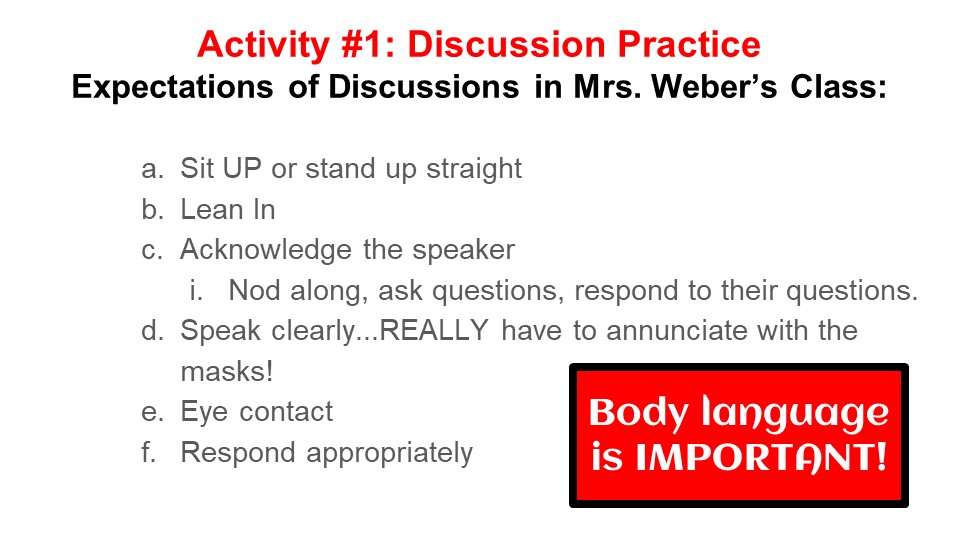
And I mean it. Almost as soon as I say that we talk about what good discussions look like. I explain (and model) my expectations for good quality discussions. What I, as the teacher walking around the room, expect to SEE and HEAR. We talk about body language and how that can convey a persons attitude and level of participation. My basic expectations for discussions in class...


I make it clear that these are the expectations whenever we have a discussion, and I go through those expectations EVERY TIME for the first two weeks. After that I simply have to say "remember our discussion expectations of what I should SEE and HEAR".

Now we practice. 4 short discussion questions to demonstrate those expectations. This also gives me a chance to walk around become a part of the conversations. I get to know what they wish teachers did in class, what they hate that teachers do, and the skills they wish school would teach them. These are great and powerful conversations. On day one. 


Now Jill, what does this have to do with Historical Thinking? 
Everything we do to start the year is training my students to "take it to the next level." This lesson is providing students the training they need with questions that are low-pressure and tend to be of interest to many kids (and rarely are they asked about it). This sets the tone so that when we have discussion topics that are more controversial and/or difficult topics, we have already established the norms for civil discourse. I find that when I am crystal clear about my expectations, they tend to be met.

The discussion (specifically that last two slides) leads perfectly into Activity #2: Employability skills. 

I went into detail on this activity with a blog post you can check out by clicking here. To summarize students identify employability skills that THEY want to leave high school having practiced and get better at. Students work together in the class to select 5 skills they want me to incorporate in the daily lessons, activities, and projects. I post them in the classroom as a daily reminder to us all. 


Activity #3: An Introduction to Historical Thinking
I have been a part of a professional learning community for 10 years or so made up of amazing Kansas Social Studies teachers around our state. A couple of years ago there was a presenter to talked about "untold stories" of history. This was the first time I was introduced to the photo of the "Orphans of the Abyss."

 I explain that when studying the past, historians ask a series of questions in order to examine the evidence they have. So we're going to practice. I tell them to discuss what they see in the photo on the next slide. 
 

And let me tell you...the conversation is amazing. The details students pull out from the photo, their reasoning...they are thinking like historians and they don't even realize it. They THINK they're just pointing out details in a photo. I love this moment so much. I walk around and nudge them for more information "What does that tell you?" or "Why do you think that is?"

We discuss their observations as a class and I go on to explain that historians are limited to the evidence they have. The more evidence that they can corroborate the more accurate their inferences are. Every now and then new evidence from past events comes up, and provides a more clear picture of what really happened. 

Then I show the next slide (which has a slight addition to the photo). 


Ohhhs and Ahhhhs fill the room. It sounds corny but I'm serious. We talk about what inferences they made that were correct and which ones were wrong.

And then I tell the story of the "Orphans of the Abyss" (Click here for the amazing story

There are always mouths open with surprise, and this moment always hits within the last 5 minutes of class. I end with this... 

History is MORE than dates and events in a textbook or vocabulary presented in a lecture. History is the story or REAL people who lived and experienced events of a nation and a world. History is ever changing and history is found in the stories. In my class we will study the stories from the people who lived during extraordinary times. We will compare their stories from multiple perspectives and ask questions in order to gain larger answers. 

And tomorrow we will find out just how we're going to "think like historians." 


Day 2 and Day 3 posts are coming soon! 

Tuesday, August 17, 2021

More than Content: Teaching Employability Skills and Making Student OWN it!

I believe it is my job to teach MORE than my content. It is my job to help students practice the skills that will be necessary in the work place. I tell all of my classes on the first day of school that I will try, as much as possible to treat them as someone in the "adult working world". 

Side note: I've always hated the phrase "real world" when talking to teens. I HATED it when I was in high school and someone told me to "wait for the real world..." Like my world wasn't real. So I make it a point to refer to the "working world" or "adult world". 

What does that look like? 

  • I allow for natural consequences to take place. If I provide time to work during class and a student makes the choice to work on another class than mine or play Pacman on their Chromebook, the consequence of that is homework or a lower grade due to a poor quality assignment. I will redirect them. I will tell them how their actions are being perceived by me. I will not get into an argument with a kid on whether or not they're on task. I don't have time for that. And teachers never win those anyway... 
  • Student feedback on the activities, lessons, projects, and organization of class is expected, asked for regularly, and taken seriously. Real-time changes and additions are made based on student feedback.
  • They will have a voice and choice in the classroom on the types of projects/activities they do and the rubrics that score them. 
  • Group projects will come with contracts where duties are outlined, consequences are spelled out, and being "fired" is a real option. 
  • Activities, lessons, and projects will be aligned with the employability skills that the class wants to focus on. 
This blog post is going to focus on that last bullet. "Activities, lessons, and projects will be aligned with the employability skills that the class wants to focus on." This is probably one of the best things I've added to my classroom in the last year, and I totally stole and adapted the idea from another amazing educator I had the privilege to work with. Follower her on Twitter @cadyjackson

This is an activity that I do on the first day of class. It follows the same general procedure as the Capturing Kid Hearts Social Contract. But instead of creating a contract in which we are all going to socially abide by... we're going to identify the employability skills that are most needed by students today. Spoiler...in order to learn and apply the skills that they choose, they will naturally have to abide by the typical social contract aptitudes of respect, responsibility, empathy, etc... By creating an Employability Skills Contract this makes that process more relevant and provides automatic buy-in from the students who took ownership of the list.

I start out by handing out a paper copy of the employability skills chart that was created by our Kansas Department of Education in collaboration with various employers across the state. The list is massive and very overwhelming to students at first. (Find the list here) I direct them to focus on the "Competency" column. While the entire chart does provide good information and can initiate great conversation, I'm also bound by time. The "Competency" column gets us right to the one or two word skills that matter. 

I do a reverse of "I do - We do - You do" scaffolding strategy. I call it "You do - They do - We do" Students start individually by writing down 10 skills they personally think are the most important or that they struggle in the most. I usually walk around answering questions and defining skills like "assertiveness" and "networking". 

After a couple minutes of alone time, I ask them to have a conversation with their team members about the skills they all wrote down. Where do they agree? Where do they disagree? Why? And then create a group list of 8 skills they can all agree are needed outside the walls of academia.

Then comes the "We do" part of the activity. I call on a group to share their list. As they read aloud the skills they chose, I write them on the board. I pick the next team to share their list. If a skill is repeated, I put a check mark. By the time each team has shared their list it becomes obvious which skills are the ones the majority of the class wants to focus on. 


***Here's where I sell it*** 
This group of young-adults, many of whom will be walking out into the "working world" in little over two years has just told me the skills THEY want to work on. The aptitudes THEY feel are the most important for their future. And it becomes my job to create lessons, activities and projects that include these important competencies while also teaching the necessary history curriculum. I post them on the wall and I refer to those skills anytime we do something that includes practice in those areas. I make sure to remind them that THEY were the ones to choose those skills not me. It's very important that I make it known in class when we are focusing on specific skills that they chose. I do this after activities, discussions, and I include the "skills of focus" on projects (as seen in the image above). 

***And here's my secret***
I was already doing this in the classroom years before we did this activity. These skills were being taught consistently to my 7th and 8th graders at Cheney. It has always been important for me to make sure to include those in my activities. The only difference now is that the students have OWNERSHIP over the selection process and more BUY IN to the reasoning. It's a win-win. 

ANNNNDDDDD they always choose the skills I want them to. Every time. 

Win-Win-WIN

Tuesday, November 24, 2020

Who Have You Asked Today?

Dear Senior of 2020, (Or Junior, Sophomore, or Freshman...)

I hope you don't mind me inserting myself right in your business....BUT. 

Have you ever thought of becoming a teacher???

Cause you'd be great. 

Amazing. 

And I've found that if I don't reach out to people who have the characteristics to be amazing teachers we (the world) may miss out on some phenomenal people in our profession. So... 

If you haven't given it a thought, think about it. I'd love to answer any questions you have. Because it is definitely a job where you get the opportunity to make people happy and have FUN everyday. There is no better feeling than going to work each day knowing that its where you belong.  

(Don't ask about 2020...but even through this crazy COVID year I still wouldn't want to do anything else) 

Have a safe and happy break. Take some time to relax. You've earned it!  

*********************************

Teachers...if we don't promote our profession, who will? If we don't reach out to those kids who would make amazing colleagues, friends, and teachers of our children and grandchildren, who's going to? Who are we missing? 

Some kids haven't even given it a thought. 

What if they did? 

Saturday, September 26, 2020

Stressed? Tips and Tricks I Learned in the Most Stressful Year of My Career

Don't hate me for what I'm about to say. 

So far this crazy COVID-school year isn't killing me. I'm not overly stressed. I'm not feeling burnt-out. I'm doing ok. 

I know, I know what you're thinking... Waaaeeellll laaa de frickin' da! Isn't that good for her. 

Keep Reading! 

I didn't say it wasn't hard. 

I didn't say I liked it. 

I didn't say I wasn't working my ass off (because I am). 

But here's the thing. Because of the job change last year, which saw me teaching in a brand new school, a new age group, and new content all while having a 4 kids (at the time) ages 7 to 5 months at home. This COVID teaching isn't much different when it comes to work load than what I saw last year. 

So yes, I'm stressed, I have more to do than I can possibly get done in a day, and my responsibilities somehow keep increasing. But I'm used to it. I "conditioned" the entire year last year in a type of environment where I was essentially a brand new teacher creating content, raiding TPT at the last minute, and trying to squeeze in grading whenever I can. Guess what...I entered more "completion" grades into the gradebook last year than I ever had before. It was survival. I worked all the time, whether it was working on school or working on my other full-time role as wife and mommy. And it was hard.  

And it broke me. I lost it. Come Thanksgiving I called and made my family cancel pictures because I had a complete melt-down over the thought of having to do one load of laundry. I wish I was kidding... 

But in the struggle I also learned a lot. I became someone who really attempted to master time-management. Because I had to. I had to be a master of the time I had.

I was just hoping that this school year the pressure and work-load would ease up. It hasn't. But I'm stronger than I was last year...so I'm able to carry it better this year.

So what did I learn? What skills did I walk away with? What do I have to offer you today? 3 Things. Just 3 things that can help you manage and budget your time so that you can start to breath a little. And these things work whether you're a parent, teacher, or student. Every single one of those groups are being thrown into the fire of school during a pandemic and all of us agree that it sucks. But we can emerge stronger... 

First Thing: Pick 6 

Chances are if you were to write out an entire list of all the things you need to do, you'd be completely and totally overwhelmed. Everyone has more to do and less time to do it. And that gigantic list doesn't do you any good. If you feel you need to get it out of your brain and on paper fine. But don't make that your actually running to-do list. Shove it in a drawer for now. 

And pick 6. Choose 6 things that you want to focus on today. Prioritize them by time and task and then set to work. But only work on those six items until they are done. Cross them off with a bright pink marker and celebrate with an iced latte from Starbucks. 

Then choose another 6. 

Sticking to only 6 things helps keep us from getting overwhelmed with too much information. Our brain gets bogged down in the amount instead of seeing in chunked portions. 

But Jill...I have more than 6 things to do. 

Yup. And you always will. Pick 6.


Next Thing: Be Goggle Focused 

I learned this term outside of a school setting and it has stuck with me more than anything else. It is my favorite time management hack. Multitasking is a lie. You can't effectively do two things at one time. (Unless you are a breastfeeding mama, then yes, darlin you can nurse that baby while doing another task) What I mean is, you can allow your brain to focus on two things or many things at once. 

Teachers are the worst at this. We will start 12 different things and then leave at the end of the day with 12 things started and nothing actually done. 

Stop it. Be "goggle focused". A swimmer uses their goggles to effectively swim the 200 Freestyle race, they wouldn't have a chance to win the race without those goggles. The goggles allow the swimmer to focus on the destination. The end. The goal. 

When you're working, whether it is planning a lesson for Tuesday, trying to complete your science worksheet, or attempting to fold a load of laundry...focus on the destination. The end. The goal. And don't stop until you do. Work until that one task is finished and then move on to the next. Before you know it you'll have all 6 items on your list crossed off. 

And even if you don't get to all 6, at least you have 2 or 3 done. Completely finished. Not 6 different things started and nothing done, causing you more stress and anxiety because a new day just brings more things to do. 


Last Thing: Get Dressed to Your Shoes

This one is really meant for those who are on some sort of flexible schedule and working from home. (Yes...if you're a student and you've made it this far into the blog post this one is really dedicated to you). You see...when I talk to my students about employability skills the one constant thing that they tell me they wish they could do better is time management. Every class, every year, time management. Well...you know what? I can't teach you how to manage time if I don't give you time to have to manage. Well now, many students, are finding themselves with tons of time they have to manage without the skills to handle it. This one is for you. 

Get up. (Yes, that means out of bed) And get fully dressed, all the way to your shoes. When we are dressed and shoes are on our feet it tells our brain we are ready to work. Seriously. We are in the right mindset to be productive. 

I know there is debate out there on whether or not shoes should be worn in the house. This is not the place for that debate. I won't tell you my opinion. But I will tell you what I know. If my shoes are off then I am sitting, lounging around and not knocking out that 6 item to-do list. It's hard to be productive when I'm in PJ's all day. 

Get dressed. All the way to your shoes and get to work. Take them off when you're done. Treat the day as if you would a normal school day and get up, get dressed, and get to work. I know it's hard. You're tired. I'm not saying you have to get up at 6:00...but you shouldn't sleep until noon, and then eventually decide to get out of bed at 1:00 only to just get started (while getting back in bed) at 2:00 and then wonder why it took your all afternoon to do that one vocab assignment. Get up. Get dressed. Shoes on. 


There you have it. 3 things that can help. Try one or try them all. See if it helps. I have more strategies but in attempt to keep this short (ha) and you from getting overwhelmed, I went with these three strategies. None of them are strategies that I fully created myself. I learned them along the way. Picked them up from different areas of life. It just seems that everyone could use a little tip on how to manage time. 

And remember to be kind to yourself. Things are going to go unfinished and get done late. You'll have to rewash the same load of laundry 3 times before you finally move it to the washer. You're going to assign a "movie day" so you can plan for the next class period. And you may have to email your teacher and ask for an extension. It's ok. You will make it through this. With a whole new appreciation for school, work, and home. 

Friday, August 7, 2020

A Structured Class During and Unstructured Year

You all know how we got here. You don't need the back story. I'm not going to spend time debating or discussing my position on whether or not schools should or shouldn't open. To be honest, I don't have time for that shit. I gotta keep moving forward with what I know and what I can do. When I sit down to start looking at what this year is gonna look like, there are all sorts of unknowns. But here is what I do know.
  1. My high school is starting off in a hybrid model. Half of my students Monday and Thursday, the other half Tuesday and Friday. Wednesdays and days when kids aren't in class are considered remote learning and students have to log 6 hours of school work (between all of their classes) every remote day. 
  2. It is my job to provide material and lessons for students who are enrolled in my class on both F2F (face to face) days and remote days. 
  3. It is silly for me to go into this year thinking that I won't miss due to catching COVID or being quarantined at some point due to my exposure to others with COVID. There is also the chance I could get really sick and not be able to get to my computer to "push" work to my students.
  4. It is also silly for me to plan on having all my students who should be in class on F2F days when they're scheduled to be there. Kids will be quarantined too. Some due to sickness, some due to exposure. It's gonna happen. 
  5. I am still responsible for the learning of my students, whether or not I or the students are physically present.
  6. At some point I need to assume it is possible for us to "out of the blue" go completely remote

Now. I have to design a class that promotes rigorous learning keeping all of those things in mind. Yeah. Not an easy task. And one that I have spend a good amount of my time obsessing about in my head for the last three months...and that has started to spill out of my brain to anyone who would listen in the last three weeks. (My poor husband...) 

And now...for now anyway...I think I have a plan. I'm going to share that plan with you today. Not because I think it is perfect. Not that I think it's the best way. But because I see teachers out there STRUGGLING to even imagine what this kind of learning looks like. This isn't just a pivot for some teachers...it's a complete jump away from what they have been doing their entire careers. It's overwhelming and stressful. I am hoping this helps with some of that. 

My Plan: My US History class will be almost 90% asynchronous and virtual, even when we are F2F. As we start the year, hopefully my students will see these three factors about our learning environment. 

Consistency: 
It's not just teachers who are going to be teaching a whole new way, it's students who are going to have to navigate this with very little prep. On top of the loss of 5 months of school. If I can do one thing to ease that transition it's to make things consistent. Each of my units will have four major components. 
  1. Historical Context
  2. Vocabulary Work 
  3. Document Analysis 
  4. Assessment (usually project based) 
This will hopefully help them know what to expect with each of our units. And while the activities and lessons that will be assigned will be different, and each unit may do more of one than the other, those 4 components will remain. 

Organization: 
Most of what I will be giving my students is going to be virtual and paperless. That's not ideal, I get that. But none of this is ideal. I have to figure out a way to help them keep track of their assignments and know what, where, and when to turn things in. This is my biggest hurdle still to figure out. I can come up with a method, but in reality it may not work. I know will use a combination of my class website, Google Classroom, and one-on-one student check-in meetings (socially distant of course). 

Flexibility: 
This is the biggie. All of those "knowns" above made flexibility my number one priority and the number one reasoning for the asynchronous/virtual environment. I need to easily be able to provide material no matter what "pivot" is sent my way. And I don't want to be scrambling at the last minute to come up with a different virtual plan when we were supposed to be F2F. In order to be flexible I'm going to have to work "smarter not harder". (PS...what is "smarter" and "harder" to me doesn't mean it is the same for every teacher...please don't take this as "your way" is not right. You do you, bruh) 

So...how does my asynchronous/virtual class look? 

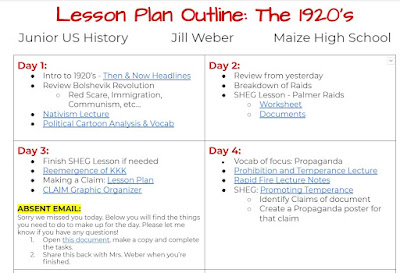
Each Friday, I will "push out" the next week's schedule to the students. It will look like the picture below. (Please see the bottom of this post for a note about the resources in this blog post). You will notice that each day gives an outline of the assignment. The students know what to expect and have all the resources to work on no matter the environment in which they are working.

Everything that I would "present" or "teach" in the live classroom will also be pre-recorded. This way if we are in person I can do the presentation live, but if I'm gone, students are gone, or we all get sent home I still have that material already created. All assignments are provided ahead of time so when students are "remote learning" they have their materials with them.

F2F days are saved for teaching technology programs, organization, one-on-one check ins, and for me to elaborate on and explain the content they are working on. Also, if I desire a quiz or test, F2F days will be used for that. For the most part "in class" time will be work time on their weekly assignments. 

This helps me in two major ways. 
  1. If students or I are gone, they know what they're doing. 
  2. If I were to become so ill that I cannot get to my computer I have the buffer of at least a week to get better. And if I don't, there will be a backup "emergency plan" with my department and administration to help. (I don't have that ready yet).
In order for my plan to work I am relying on at least a few F2F days to train my students and have them prep and practice what they will be doing. If we don't end up with that, I can make it virtual training, but that will be much more difficult. Not impossible. Just more difficult. 

The big downfall. My "F2F" classroom is not in anyway going to resemble what is really good teaching or what the kids are begging for. They WANT normal. They WANT interaction. They WANT active learning. And that is minimal with this plan. We will discuss, interact as much as we can, but none of this year is going to be what we really want it to be. I am doing what every single teacher out there is doing. Trying to do what is best at this moment, knowing (painfully knowing) that it's not good enough. 

As the year progresses, maybe...just maybe we'll be able to get some consistency in our world. Numbers of COVID spread will stabilize and we'll be able to add in some more "live" lessons, activities, and projects. I am, and will always be, hope for that. 


***A note about resources***
You are welcome to look at and use the lesson I created for our first unit, the 1920's as detailed in the above picture of the weekly plan. Please understand a few things. I am not completely finished with it and I do not plan on going back into this shared folder and adding/changing anything. Please don't contact me and ask if I finished it...you will have to take it from there. Also...some of this is created by me, but a lot of it is pieced together from a variety of resources. None of this should show up on TPT. Thanks for that consideration. 

Link for 1920's Asynchronous Folder: CLICK HERE 

Tuesday, August 4, 2020

Teaching and Cycling: An Analogy

I recently took up cycling. My husband has been riding for the last 5 years and is a pretty serious riding 30-70 miles on a regular basis. Over the years I have developed a desire to try riding a bike for exercise. I have bad knees and limited amounts of time being a teacher and a mother of four young children. This was something I figured I could squeeze in that wouldn't make my knees swell up like cantaloupes.  So he got me a bike for Mother's Day, and I've been riding all spring and summer. I've come to realize that how good you feel on a bike can completely depend on the wind. And here in Kansas we have a lot of wind. Basically you will encounter one or a combination of the following three scenarios.

A tailwind, giving you a nice push and making your ride seem easy.

A head wind, making the ride 10 times harder and usually involving a few choice words as I push through.

And a crosswind, which isn't as hard as a headwind, but is tricky because sometimes you THINK it's a headwind until you turn and realize that the wind is blowing much harder this direction.

Of course any of those scenarios can come with the route that you ride. Could be uphill, could be downhill, could be flat land. How you feel about your ride totally depends upon the combination of all of these things.

And one morning as I was pushing up a hill (and probably swearing) I was started to think that cycling is an excellent metaphor for teaching. 

Allow me to explain.

For 13 years I worked at a middle school in a small town. And while there were moments where it may have been a little bit difficult for the most part it was easy. And it was fun! Essentially this was a bike ride with a tailwind. And while there might have been a few hills along the way (maternity leaves, new admin, student teachers, new standards, new technology...) I still had the wind pushing me in the back allowing me to remain, mostly, comfortable. Easy.

Eventually that got too easy. There was no challenge left in that road I was taking. It was flat land with a huge tailwind. I couldn't push myself anymore where I was. So I changed directions.

All of a sudden I found myself riding uphill with wind in my face. I had made a huge shift in the direction I was going. Now I was teaching a brand new content, and a brand new school, to a brand new age group. All while having four kids under the age of seven. It was a crazy ride! As I kept going and as I pushed through it started to get a little easier. The hill started to flatten out a little bit the wind started to die down. In January I felt like finally I was feeling more confident and I was growing stronger. It was exciting! I could just tell that come next August that wind was going to shift back into a tailwind helping push me through the hills that would come.

Nope.  As often it does, unexpectedly the wind changed. Instead of shifting into a tailwind. We were all forced to ride straight into a headwind. A strong headwind. Uphill. 

Now as I approach the teaching year in August of 2020 I find myself looking at a very long and windy uphill ride. And there's no clear view in the forecast of when that might change.

But I know all I have to do is keep going. Keep pedaling. There's no reward for finishing first. And while some of us have been riding for a while and have tools and tricks and muscle built up to push us through. We have some that will stop, they are tired of the ride and won't do it anymore. And that's okay.  We also have brand new cyclists. Who are not starting out on a flat road with wind behind them, they're starting out with a huge hill and a strong head wind. They're going to need coaches that cheer them on and ride next to them as they struggle.  We may need to find new tools and equipment that can help us push through. We'll have to just keep moving forward, even if it is slow. 

So what can we take away from this analogy?
1. Slow progress is still progress. Even thought it may not seem that way and it will be hard...and probably consist of a few muttered "choice" words. It's still progress.

2. There is no room for comparison. I ride at an average sustained 13.5 mph on a good day for 8-12 miles. My husband rides at an average of 20 mph and goes on 50 miles rides. For fun... (WTH??). It does me no good to compare myself to him. He has different goals and is in a completely different kind of shape than I am. Same goes for teaching. Look to learn from those who are better...not feel defeated because you don't know or do as much. It's ok to be where you are as long as you're working on progress. 

3. We're gonna need to rest and take care of ourselves along the way. Long rides don't happen without some self-care along the way. Otherwise you put yourself in danger. Take your personal days. Leave your computer closed and find ways to regenerate! 

And...

4. Eventually the wind will die down and the land will level out. And when it does we will emerge from that ride amazed at how much stronger and confident we are.