Thursday, May 21, 2015

The Girl Next Door

I am now closing my classroom door for the 9th year in a row.  In many ways, this was one of my best and favorite years.  Most of the reasons involve things that happened inside my classroom.  It was a fun year.  I enjoyed what I was teaching, how I was teaching it, and found myself excited about the things to come.

However, one of the reasons for "the best year so far" didn't happen in my classroom.  It happened in the one next door.

You see.  My sister was teaching in that room.  Her second year of teaching, first one at Cheney.

It was about this time last year that we knew we would be seeing A LOT more of each other.  Everyday.  All year.

I know this happens in small schools all across the country.  But for us, when she applied for the 6th Grade Communications job, we both initially saw it as a long-shot.

But then she got an interview.

And the call with the offer to teach in the room directly next to me.

Surreal.

Growing up, we fought quite often.  Only four-and-a-half years between us, and different personalities made for interesting times sharing a bedroom.  However as have grow up and become successful adults we have grown to appreciate our differences as well as seen them shrink.

The highlights of this year shared with my sister include...

The first day of school selfie we sent to our mother (who is VERY jealous of us working in the same school).


Twin Tuesday.  We dressed alike for the first few Tuesdays of the year.  Then we got busy and forgot.  Or ran out of matching clothes.

I "Shushed" her.  In a meeting.  And didn't even realize I did it until is was pointed out by another staff member.  They thought it was hilarious...

She told my class of 7th graders that they didn't have to do anything all day.  They believed her.

I told her 6th graders that I am WAY cooler and they better believe me because I will have them for the next TWO years!

She stepped outside of her box and directed the 8th grade play.  I am so amazed by her determination to learn something new and then have it turn out awesome.

We learned out personality "colors."  I am GOLD which means I like things organized, on time, planned out, and I'm bossy.  Yep.  That's me.

She is ORANGE.  Go-with-the-flow, creative, not on time (or doesn't stress about time).  Yep. That's her.

She entertained the staff with stories about her miraculously cured eyesight, which she determined was her healthy eating habits, that turned out to be two pairs of contacts, and astonishingly announcing that they "let a man eat a little boy for his last meal before execution" only to find that the article was published by The Onion.  -- We were in tears.

And finally...the last day of school selfie we sent to mom!


Here's to more great years with the girl next door :)

Monday, May 18, 2015

Infographics: My 8th Grade Final

We made it!

May.

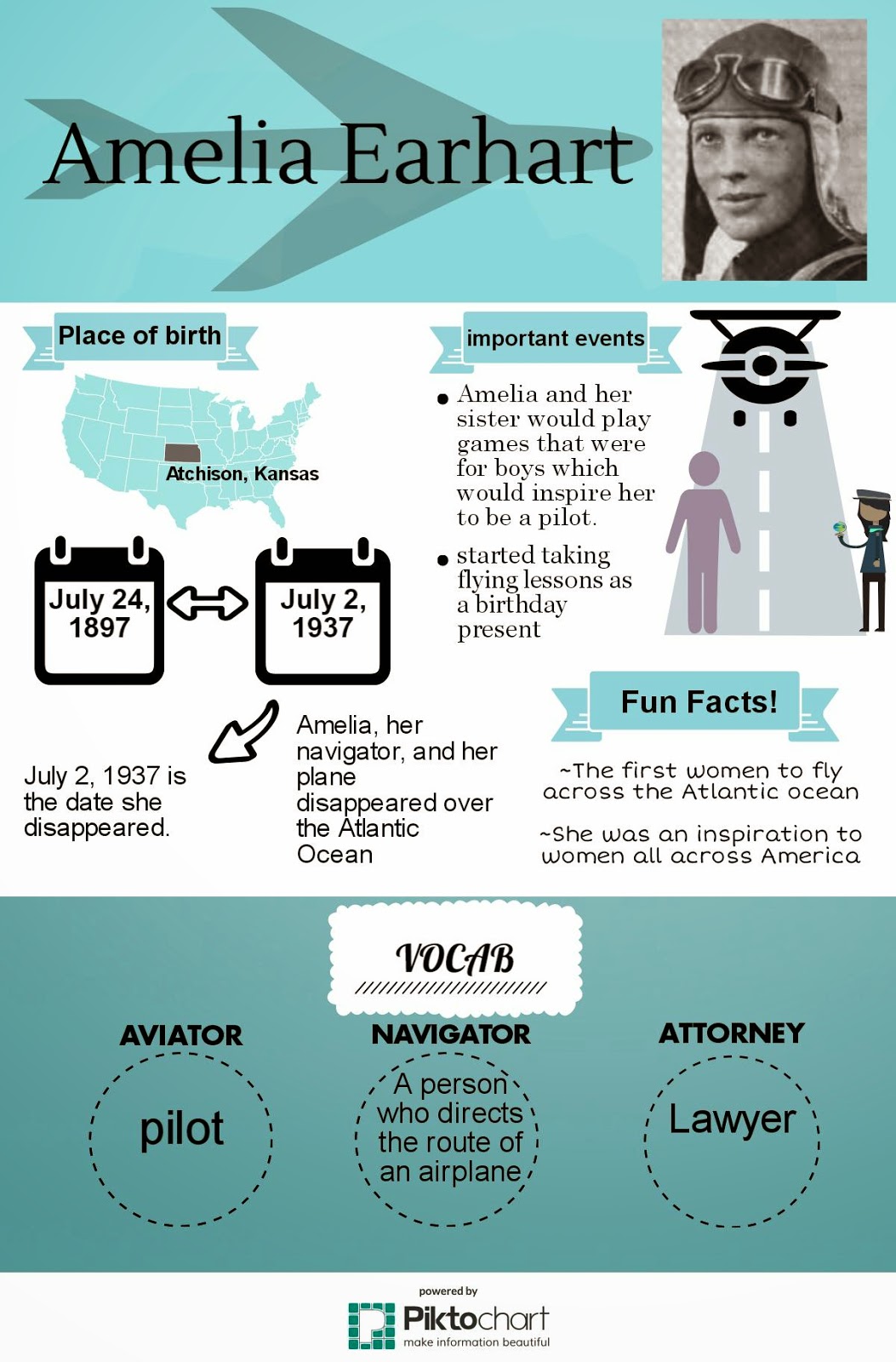
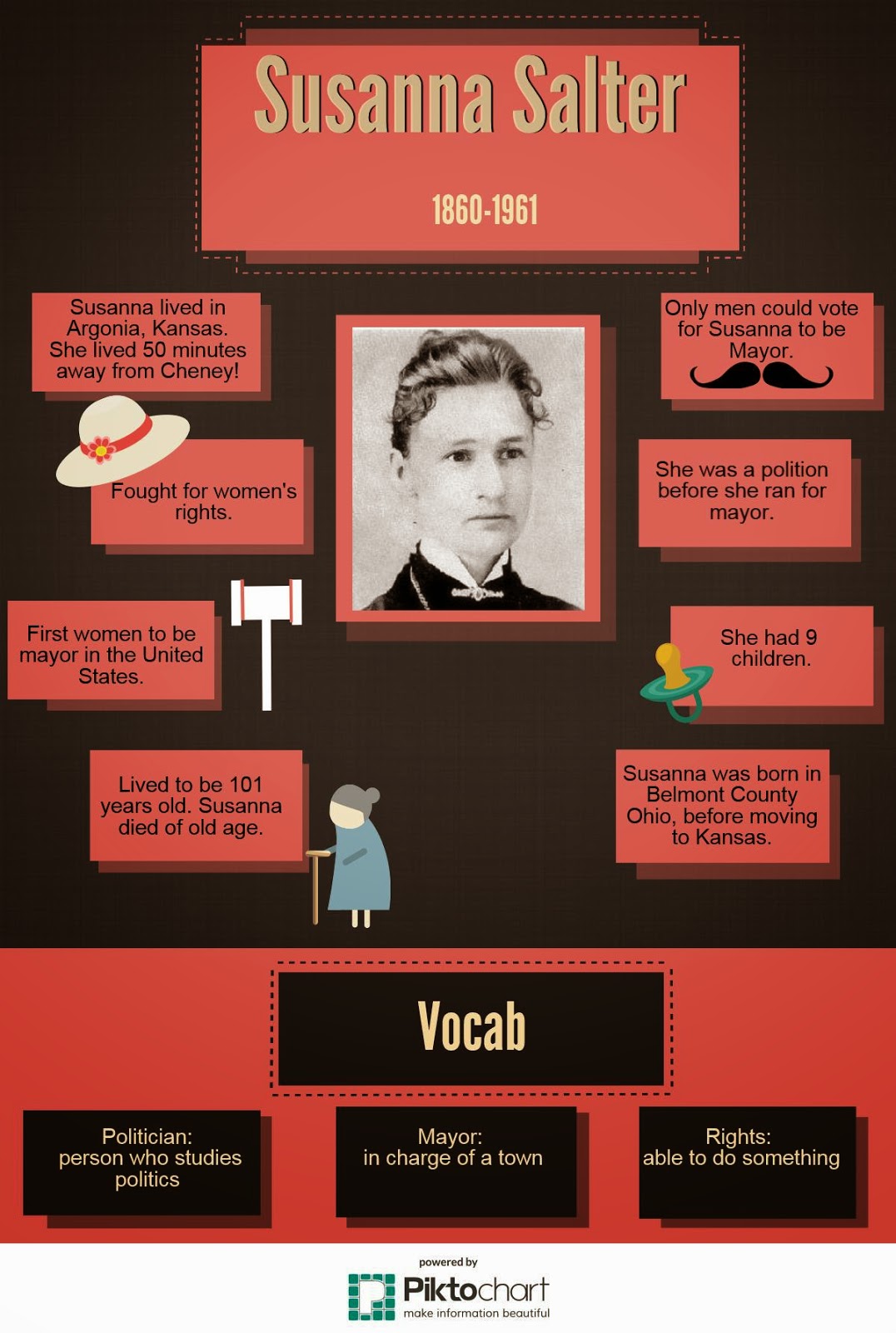
My 8th grade students have actually been waiting and looking forward to their Social Studies Final this year.  They knew it was coming.  I did a "practice round" of infographics earlier in the year.  (Read about that here.)

Infographics are a visual image such as a chart of diagram used to represent data.  Infographics can help you simplify a complicated subject or turn an otherwise boring subject into a captivating experience.

After our practice round I felt confident that the students would be able to use Piktochart and improve from their first attempt.  I specifically showed the kids a few "tricks" that I learned from some of those "overachievers" the first time.  I showed both good and bad examples of things I wanted and didn't want.

Every single student improved.

I was so impressed to see how they took a couple of suggestions on fonts, text boxes, backgrounds, and pictures and ran with it.  Their topics were taken from the 4th Grade Kansas Social Studies Standards.  Not only did they have to do research on each topic, but they also had to remember that their audience.  4th Graders.  Everything on the page had to be written at a level they could understand.

Enough with the words.  Let's see some of the final products.  **I asked permission from the students to use their infographic and list their names as the creators.**  This is just a sample of many, many great results!

Created by Will
Created by Hunter

Created by Johnny

Created by Morgan

Created by Ben

Created by Emory

Created by Natalie

Created by Jaiden
Created by Taryn 

What I learned from this project...

  • The kids love this!  By far this was the most well-received project I have done all year.  The kids KNEW they had to do a good job.  They KNEW the final product would be used.  
  • I love Piktochart.  They have the "self-guided" tour to allow the students independence in learning the program.  I didn't have to guide them every step of the way.  It truly was independent. 
  • With a good, solid rubric, this was easy to grade.  
  • The peer evaluations were super effective for everyone involved.  I warned them that as they are critiquing their peers it is NOT their job to guard the feelings of their partner.  It is their job to point out what does and doesn't work on the poster.  
  • The pairing of the peer evaluations were differentiated.  Those who struggled with design last time were evaluated by those who have a knack for design.  Those who excel at content were to evaluate someone who struggled with gathering information.
  • Compliments from me were genuine.  Faced beamed with confidence.  I even overheard "Hey, did you see my infographic?  I'll show it to you it's awesome."


I first got the general idea for making infographics at a conference I go to four times a year.  We are part of an original group who came together because of a grant from Teaching American History.  I wrote about this group here.

I cannot stress enough how important it is for teachers to attend and participate in professional development workshops.  As we dive into another round of school budget cuts, I am fearful that many teachers will lose the opportunity to attend workshops because it can be seen as an "easy" cut.  However, research has shown time and time again that the most important factor in a students' successful education is the teacher in the classroom.  I hope that districts across the country will continue to support the continuing improvement of all their teachers.

Thursday, April 30, 2015

Gummy Governments

Want a fun way to teach (or review) the different types of governments with your students?

PS...if you're not using Pinterest yet to search for ideas for your classroom...what are you waiting for?  It's not just a place to get recipe and craft ideas, there are some cool classroom activities, lesson plans, and organization strategies that can easily be modified to fit your needs.

I found this little gem of an idea there earlier this year.

Have your students "illustrate" the different types of government using gummy bears!

We focused on...
  • Monarchy
  • Dictatorship
  • Oligarchy
  • Direct Democracy
  • Representative Democracy
  • Anarchy - not really a "form of government" but fun to act out with gummies!
  • Theocracy 
  • Coup d'etat 
  • Revolution
I had our kids work in partners or groups of 3 depending on the class size.  They were to give the definition of the type of government and then create an example of that using gummy bears.  Red for citizens, yellow for those in power.

We had fun!

Monarchy:


Dictatorship:


Oligarchy:


Democracy:


Anarchy, Coup d'etat, Revolution:


Friday, April 17, 2015

Rewriting the Gettysburg Address

WHAT??

What good could it possibly to do rewrite one of the greatest presidential speeches of all time?

In an 8th grade classroom... A lot of good!

As awesome as Abraham Lincoln was and as impressive as his Gettysburg Address is, it just isn't written in language our 8th graders "get."

So we rewrote it.

Each pair of students was given a short phrase or sentence of the famous speech, with the task to make it shorter and easier to understand.

When they were finished they each read their statement aloud, and we taped them together on the board to create our very own version of the Gettysburg Address.


The final results...


Some of the comments I heard throughout the class period...


  • Wow!  This is way easier to understand.
  • Oh, now I get it.
  • This was fun!
  • Yay, we got an easy one! :-)

Monday, April 6, 2015

Making Connections

I went to a Social Studies conference at the end of February.

I have a love/hate relationship with professional development conferences.  I hate, HATE to be gone from class.  However, I love to collaborate with other social studies teachers and learn new strategies to use in the classroom.

Workshops that end up being successful in my eyes are the ones where I can walk away and implement a new strategy or activity right away.

February provided just that!

High School History Teachers, Paul Kitchen and Tiffany Houle, from Wichita Public Schools presented about using History Labs in their classrooms.  Their presentation rocked and gave me a great new idea to add to my unit assessments.  In fact, I did.  I added it the next day...to the test kids were going to take at the end of the week.


I call it Making Connections.  (I don't remember if that's what they called it).

Here is is... (formatting may look a little weird...I just copied it directly from my test)

Making Connections:
All of these events listed occurred between 1860 and 1925 however; one event in each group does not fit with the other events three.  highlight the THREE events that fit together.  Then complete the writing prompt below.
Group 1
Group 2
Group 3
·   Temperance Movement
·   Cattle Drives
·   18th Amendment
·   Carry A. Nation

·   Susan B. Anthony
·   Women’s Suffrage
·   The Civil War
·   19th Amendment
·   Swat the Fly Campaign
·   Dr. Samuel Crumbine
·   Public Drinking Cub
·   Industrial Revolution


Writing Prompt:  Choose one of the above groups (1, 2, or 3) of events.  Explain how the events that are highlighted are related to each other.  Explain your answer with at least two details discussed in class.  You need to have at least 4 sentences.


My 7th graders were completed this task and did an excellent job for the first attempt.  I also included a rubric to help in the scoring of this task...


X2 Content:  Part 1 – 10pts
5
3
1
·         Each event highlighted is mentioned.
·         Used at least TWO specific details from class to explain how each event is connected.
·         Stated things clearly.
·         Info was correct.
·         One event that was highlighted is left out.
·         Used at one specific detail from class to explain how each event is connected.
·         Stated things somewhat clearly.
·         Info has one error.
·         More than one event that was highlighted is left out.
·         OR incorrect event highlighted.
·         No specific details from class.
·         Not clear.
·         Info has more than one error.
conventions (cap use, complete sentence use, ending pun’t., spelling,) (5 pts)
5
4
3
2
1
all correct
only 1-2 errors
3-4-5 errors total
6-7-8 errors total
9-10-11 errors : (>11= 0)


I loved how this made the students think critically and connect important events together, and at the same time they got to choose which of the three topics they knew the best to write about.

This is definitely a keeper!

PS...There were many presentations that had great material for teachers to use.  If you want more ideas, click HERE for a link to the conference materials from different presentations!

Tuesday, March 10, 2015

Four Corners

I have a new strategy I used today.

I LOVE IT!

I actually found it on Pinterest over the summer and saved the idea for a rainy day.

Well, you should definitely use this activity even when it's not raining!

I'm calling it Four Corners.

I am sure there is some other teaching strategy that is already called "four corners" and I'm not trying to take anything away from that.  This is just what I call this one for my class :)

Four Corners offers an awesome solution to the "I hate group work because I end up doing all the work and "Janie" ends up sitting there doing nothing and copying my answers..."

Or the... "Bobby always says the answer and won't let us give our opinion..."

This strategy holds Janie accountable and keeps Bobby from taking over.

And encourages kids to work in teams.

And engages students.

Win.  Win.  Win.

Here's what you need.

  • Sticky notes for each group. Each student will need one.
  • An essential question that needs to be answered.  Our was "Do you think the Texans were justified in declaring independence?  Explain your reasoning with evidence from the documents (we had 4 primary source documents to work with.)
  • A full sheet of paper with a note-card in the middle and the numbers 1, 2, 3, and 4 surrounding the note-card (or a text-box with lines, or just a box...whatever works for you)  Here is what I had...

  • After your lesson have the students answer the essential question on the sticky note individually.  
  • While they are working put the paper with the numbers and note-card at each group.
  • Once students are finished answering the question on their own, they place their sticky note on the paper over one of the numbers.  Now the group must come together and answer the question as a team and write one group answer down in the middle.  

Now you have each student participating, working together in a team, and engaged in the lesson. 

Win. Win. Win!

Enjoy!

Tuesday, February 10, 2015

Tips for Adding Writing to you Classroom: From a Non-Writing Teacher

I teach Social Studies.

I took history classes in college.  Many of which required me to write papers instead of take tests.  Most of my professors (if not all) did not grade on writing conventions, they only cared about the content.  I didn't take ONE literature, English, or writing class in college (took Honors English as a Senior in high school so I could get that credit out of the way.)

I was NOT trained on how to teach writing.  At all.

So, when I was told a few years ago that I needed to start incorporating more writing into my Social Studies classes, I panicked. How can I require kids to do something that I'm not even sure on how to grade it?  Or what to actually require of them?  Or what to actually say?

I had two choices.  Refuse to change what I was doing and ignore the requirement, or figure it out.

Over the last few years, I have been working on figuring it out.  Here is what I have done.

These are tips for teachers who aren't trained to teach writing, from a teacher who wasn't trained in writing instruction.  I hope it helps calm some fears and make this writing thing a little more doable.

Collaborate with your writing teachers:  Do it now.  First thing.  Go down the hall and tell them that you want to add more writing assignments to your classroom and you would like to mirror what they do in their classroom.  Trust me, they will appreciate it!  Use the same language they do.  Our 8th grade teacher, Mrs. Rohloff, uses a fun method to get kids to write better paragraphs.  It's called Ninja paragraphs and it's awesome.  She teaches it, requires it out of the students, and that makes it easy for me to mirror.  All I have to do is tell the students they have to use the Ninja paragraph format and they know what to do!


Our 7th grade teacher, Mrs. Harris, started doing these really cool short "on demand writing" activities in her class in order to prepare the students for the new multidisciplinary writing state assessment.  Guess what I'm going to add to my class??  Yep.  Short, on demand writing prompts based on the content we are studying, using primary source documents,  and her template as a starting point. The kids are already familiar with the process, I just add in the content.

This is Mrs. Harris' On Demand Writing assignment.  See cool stuff!

Here is mine.  I took her form and adapted it to fit my content and requirements.  Notice how I only grade on the writing conventions that I can confidently pick out.

A HUGE shout out to Cheney Middle School's 7th and 8th grade Communications team!  They have helped me out SO MUCH the last three years.  I am becoming a better teacher every day because of them!
Melodie Harris and Holley Rohloff, my "Go-to Gals" for all my writing needs!

Start Small:  Don't freak out and think all of a sudden you have to include a 5 paragraph essay with introduction and conclusion.  Start with complete sentences.  Make students respond using complete sentences ALL THE TIME.  They will hate it.  They will ask why they have to do it in your class and some will protest by continuing to write one word answers.  Do it anyway.

Grade what you know:  Every teacher in this profession knows that a complete sentence starts with a capital letter and ends with punctuation.  Grade it.  If you require a complete sentence and they don't capitalize the first letter, count off for it.  I take a 1/2 point off EVERY TIME they don't capitalize the first letter or put punctuation.  And you know what??? All of a sudden my students started to remember to do this very basic skill.

Ask "Why?" or use the phrase "Provide evidence from the text."  These are some of the first things you should add to your questions.  Always make them explain HOW they know something and reference the text or provide details from a class discussion.  Hold them accountable for how they know the information, and make them back it up.  Other good questions..."How do you know this?"  "Explain your reasoning by using at least two specific details learned in class"  or my personal favorite... "write an adjective to describe this person and provide a quote to support your choice."

Use the acronym T.A.G.:  TAG stands for T - Turn the question into a statement.  A - Answer the question.  G - Give more detail.  This always requires the students to answer the question in TWO complete sentences.  They hate it at first, but eventually they become accustomed to the requirement and their responses are SO MUCH BETTER!

EXAMPLE: What was William Marbury's complaint in the case of Marbury vs. Madison?

Real example of student response NOT USING T.A.G. **No words have been changed**
  • Wanted the position he was promised 
Example of student response WITH T.A.G. **No words have been changed**
  • Marbury's complaint was that he was to be a judge, but Jefferson refused to give him this.  He went to the Supreme Court to get a "writ of mandamus" because he wasn't going down without a fight.

Tic Tac Tell:  I first got the idea for this from Glenn Wiebe's tip of the week post.  It is awesome.  Stop requiring students to only memorize the definition of vocabulary words.  Take the standard requirement of "use the word correctly in a sentence" to the NEXT LEVEL with Tic Tac Tell.


Mix it up:  You don't always have to incorporate writing by having kids write paragraphs or sentences.  Throw in some poetry writing...again, piggy-back off of what the English teachers do.  When they teach poetry, have your kids write a haiku over women's suffrage.  There are great resources out there for adding poetry writing to your classroom.  I personally love combining poetry writing with photographs as the picture below shows examples of 7th grade haiku's using the knowledge of our study of Women's Suffrage and a photograph I provided.


This hasn't been an easy move for me, it has been a challenge, but I love a good challenge.  I love to seek out ideas and strategies that will make me a better teacher and allow for more creativity in my classroom.